

Trump begins Asia trip with Quad meeting in Manila
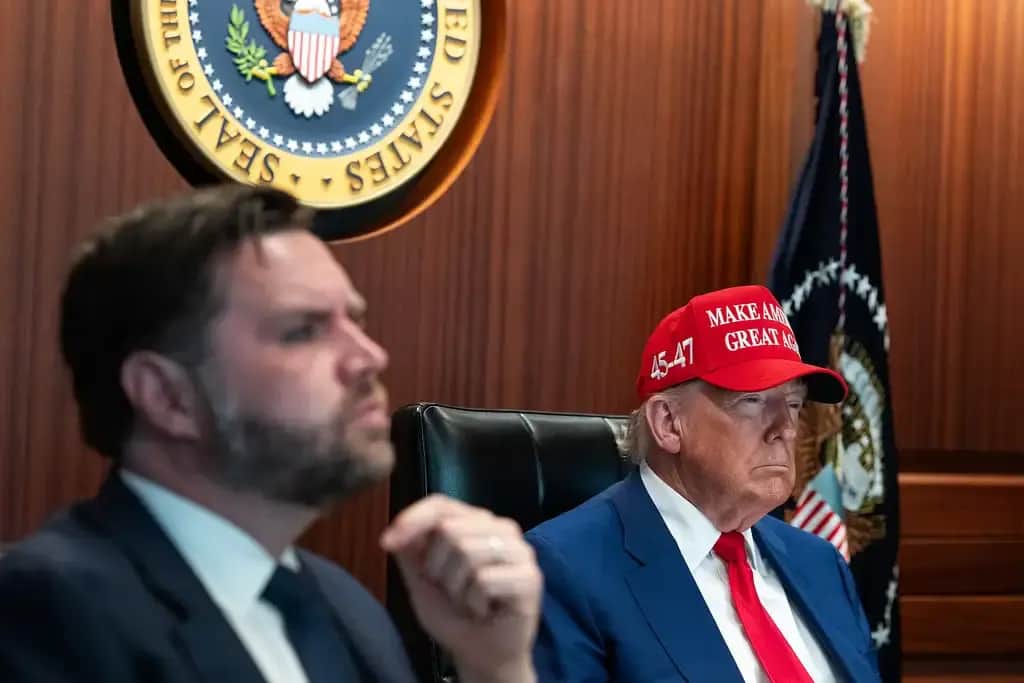
Donald Trump was due to arrive in Manila for the first Quad leaders’ meeting in two years. The group includes the United States, Japan, Australia and India. According to Reuters, the trip also included the APEC forum in Shenzhen, China, and trilateral talks with the leaders of China and Russia.
The Quad meeting was planned shortly before the APEC forum, hosted by Chinese President Xi Jinping. China had previously objected to the grouping, viewing it as an attempt to encircle Beijing. Quad members, by contrast, say the group is not directed against any particular country. Trump’s predecessor, Joe Biden, regarded it as one of the United States’ key foreign policy initiatives.
Reported by Mezha.
Ahead of the meeting, a Japanese foreign ministry official expressed hope that the leaders would demonstrate unity. He named maritime security, export restrictions, diversifying supply chains for critical minerals and artificial intelligence among the possible topics. Kurt Campbell, a former U.S. deputy secretary of state, said the meeting could send a strong signal ahead of talks between the United States, China and Russia. He also described relations between Washington and Tokyo as central to U.S. policy in Asia.
White House spokeswoman Olivia Wales said that under Trump, the Quad had proved to be an effective partnership that tackles the region’s complex problems and creates opportunities for a free and open Indo-Pacific. Campbell noted Secretary of State Marco Rubio’s role in choosing the timing of the meeting and bringing the group together again.
The trip came after the Republican Party’s defeat in the midterm elections. Meanwhile, espionage allegations could complicate the fragile truce in the U.S.-China trade war. Trump’s arrival in the Philippines coincided with the conclusion of the summit of Southeast Asian countries. According to Reuters, demonstrations took place in Manila for several days before his arrival: participants burned effigies of the president and called for an end to the war in the Middle East and the cancellation of the U.S.-led Pax Silica initiative.
Meanwhile, Chinese Premier Li Qiang praised China’s and ASEAN’s economic achievements on Monday despite global trade restrictions. He said Beijing remained committed to free trade and urged the parties to stick together and cooperate. China is ASEAN’s largest trading partner and a major source of investment. The bloc has 11 members and a combined GDP of more than 3.9 trillion dollars; the grouping’s largest economies had sought to deepen ties with the United States despite trade and diplomatic uncertainty under the Trump administration.
Trump was expected to skip the annual East Asia Summit but attend a special U.S.-ASEAN summit. A meeting with Philippine President Ferdinand Marcos Jr., a U.S. defense ally, was scheduled for Wednesday. A meeting with Thai Prime Minister Anutin Charnvirakul was also expected on Tuesday, Thai media reported, citing the trade minister. After talks on a reciprocal trade agreement, the parties were expected to issue a joint statement.
Trade ties were an important backdrop to contacts with Thailand: this year, the United States accounted for 24% of the country’s total exports and was its largest export market. In 2003, Washington granted Thailand the status of a major non-NATO ally.