

Financial Times: Russian military spread AI videos about fabricated frontline successes
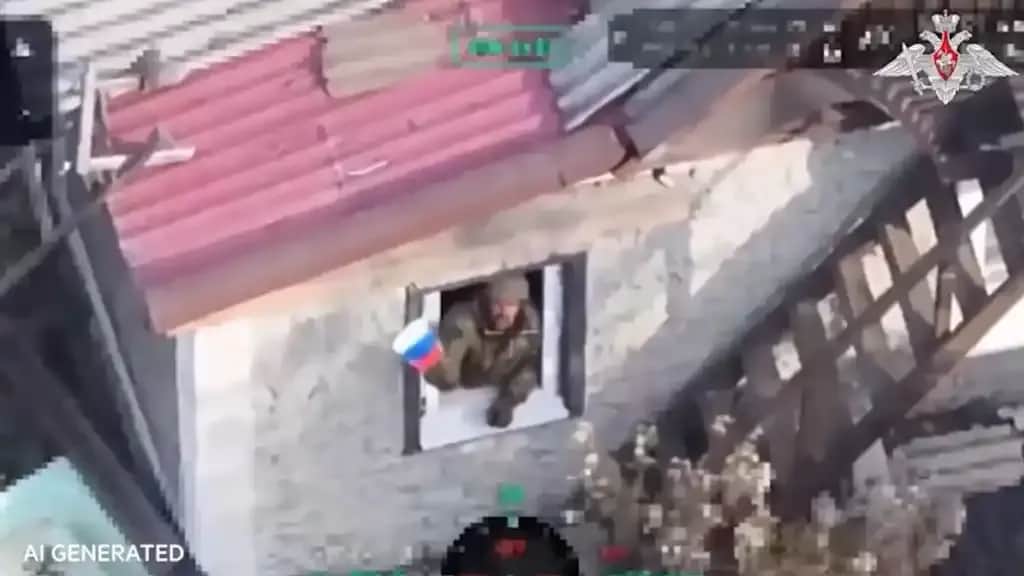
According to Mezha, citing the Financial Times, Russian military personnel are spreading videos created or altered with artificial intelligence to portray nonexistent successes. Analysts identified at least 35 videos showing signs of possible manipulation.
One such case involved Dobropillia in Donetsk region. In mid-October 2026, Russian commanders reported to Vladimir Putin that they had allegedly captured the city. Afterward, Russia’s Ministry of Defense published video showing destroyed buildings, with soldiers displaying flags among the ruins in some clips to create the impression that they controlled the settlement.
Reported by Mezha.
Financial Times journalists drew attention to a flag that changed position unnaturally in one clip. Ruslan Leviev, head of the Conflict Intelligence Team investigative group, explained that the change could not be attributed to video compression or camera characteristics. In his view, the clip had been falsified.
The claim that the city had been captured did not match the reported course of events on the ground: according to Mezha, almost three weeks later, Ukrainian military personnel continued to hold positions in Dobropillia. This example shows how video of flags and ruins could reinforce a claim of control over the city, although the presence of such footage did not itself confirm its capture.
Experts at the Institute for the Study of War (ISW) analyzed materials circulated by Russian military units and pro-war bloggers. They identified 35 videos that were likely either entirely generated or altered using AI. Signs analysts looked for included unnatural human proportions, people or flags suddenly disappearing, and other visual inconsistencies.
Some of these videos later appeared in Russian state media and official information channels of Russia’s Ministry of Defense. ISW warns that modern generative tools can create videos without obvious visual errors, making fakes harder to detect. The spread of such materials makes it more difficult to verify information about the situation on the frontline, especially when they are published by official sources.
Daniel Mealy, head of ISW’s geospatial intelligence team, views the videos as part of a broader Russian information campaign. Its aim, he said, is to create the impression that Russia’s victory is inevitable and convince Western audiences that Ukraine’s defenses are nearing collapse.
In its account, Mezha says the Financial Times links the spread of such materials to the situation on the frontline: after Russian forces made gradual advances in 2024–2025, the pace of their offensive slowed in 2026 amid significant losses and Ukrainian counteroffensives. A source close to the Russian leadership told the publication that Putin’s demands for results encourage some commanders to exaggerate their successes. Some Russian military bloggers have also acknowledged that Russian units use AI-generated videos.