

Spain’s election debate: Sánchez and Feijóo clash over the economy, migration and more
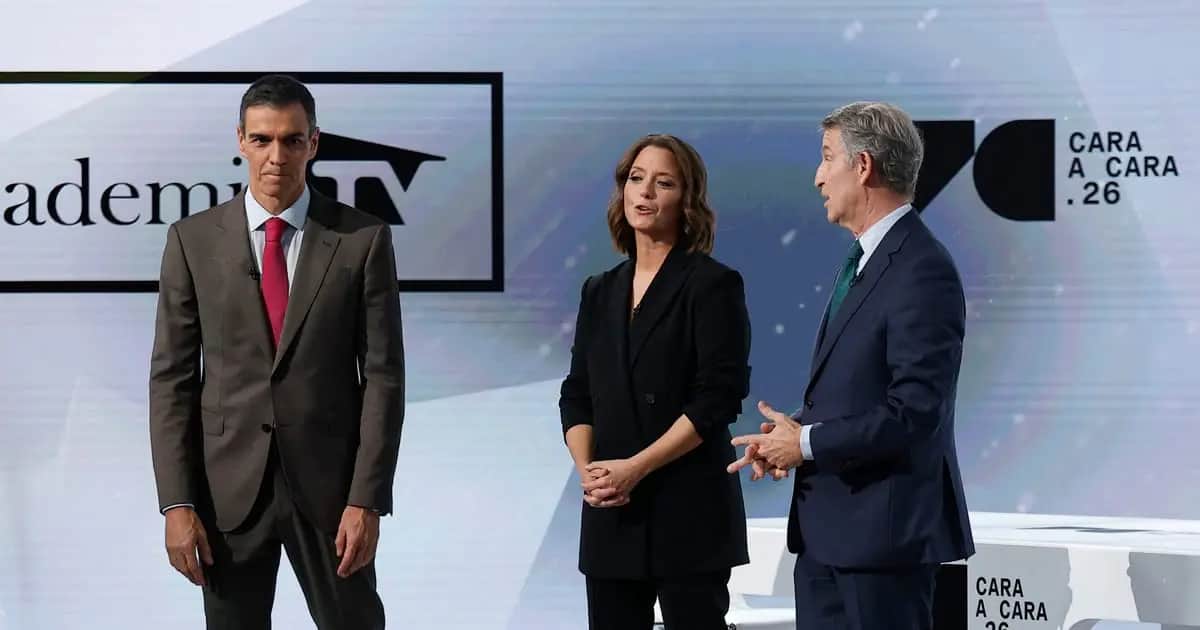
Spanish Prime Minister Pedro Sánchez and People’s Party leader Alberto Núñez Feijóo traded accusations in a televised debate ahead of the general election. POLITICO describes their dispute over railways, housing, the economy, corruption, migration and foreign policy as a tense battle for undecided voters.
The debate took place on Thursday evening amid a close contest between the two largest political forces. According to a poll cited by POLITICO, Feijóo’s People’s Party was backed by 29.5% of respondents, Sánchez’s Socialists by 27.2%, and the far-right Vox by 19.6%. The outlet noted that the right-wing bloc was nearing half of the vote and that the election result could open the way to a government backed by Vox. The same data showed that 55% of the electorate were still unsure whether they would vote, so both politicians tried to persuade undecided voters.
Reported by politico.eu.
Feijóo sought to present himself as a reliable alternative and focused on Sánchez’s government record. According to POLITICO, he used this year’s two fatal rail accidents to discuss the state of the high-speed rail network, once regarded as a source of national pride. The PP leader linked the network’s deterioration to corruption and neglect, and questioned whether passengers could continue to travel by train without fear. He also criticized the prime minister for failing to deliver on housing promises. Sánchez, who called the housing crisis the main reason for calling an early election, responded by repeating his promise to introduce progressive housing measures if re-elected.
Railways also prompted personal attacks. Feijóo noted that Sánchez had not attended the funeral of the victims of the recent disaster in Adamuz and claimed that the prime minister had danced at a campaign rally just 48 hours after the tragedy. POLITICO presents this as an allegation by the PP leader, not as an independently verified fact. The attack reflected Feijóo’s general approach to the debate: according to the outlet, he went straight on the offensive and repeatedly questioned Sánchez’s integrity, while the prime minister tried to project composure.
Corruption allegations also flew in both directions. Feijóo listed scandals and judicial investigations involving people close to the prime minister and promised to “clean up” the country if elected. Sánchez responded by calling the People’s Party the most corrupt in the country’s history and citing court cases in which, he said, PP representatives had benefited from kickbacks and illegal payments. Feijóo dismissed those accusations as relating to the distant past. These were claims made by political opponents during the debate, not findings established by POLITICO in its account.
The candidates offered different assessments of the economy. Sánchez cited economic growth and job creation under his government. Feijóo disputed that ordinary Spaniards felt those results and accused the prime minister of worsening the position of the middle class through his policies. To combat the rising cost of living, the PP leader proposed large-scale tax cuts. Sánchez warned against a sharp reversal in economic policy and noted that six out of ten households receive more from the social security system than they pay into it. He also promised to raise the minimum wage every year until it reached 60% of the average wage.
Sánchez separately asked whether Feijóo would maintain the indexation of pensions to inflation. The previous day, a PP representative had expressed doubts about the sustainability of the system, but Feijóo himself said he would not change it. The People’s Party leader also criticized the government for not passing a national budget since 2023 and promised to submit a budget every year and seek its approval. POLITICO noted that pensions are a sensitive issue: people aged 65 and over make up 28% of Spain’s voters.
Migration, in POLITICO’s assessment, became a prominent campaign issue and was linked to Vox’s rise. In July, more than 70 thousand undocumented migrants arrived in Ceuta, a Spanish enclave in North Africa, which, the outlet writes, heightened voters’ attention to the issue. Sánchez defended migration’s role in the country’s economic model, particularly given the ageing native-born population. Feijóo, by contrast, linked it to “danger” and promised tougher controls; Sánchez accused him of stigmatizing migrants.
The leaders also argued over which position on migration was in line with Europe’s approach. Feijóo called Sánchez’s stance too liberal and cited a letter from European leaders criticizing the Spanish government’s actions during the Ceuta crisis. Sánchez turned the discussion to the People’s Party’s willingness to cooperate with Vox: he argued that Feijóo was the one departing from Europe’s political mainstream, citing the example of German Chancellor Friedrich Merz’s party, which refuses to cooperate with the far-right Alternative for Germany.
On foreign policy, Sánchez cast himself as a progressive leader standing up to Donald Trump and the global far right. He also defended his opposition to the wars in Gaza and Iran, arguing that it had helped Spain become a “beacon” in a world where the far right and the influence of tech oligarchs are growing. Feijóo mocked the prime minister for paying more attention to international affairs than to Spaniards’ everyday problems and urged him to focus on railways. The politicians also disagreed over defense spending: Sánchez defended his refusal to increase it at Trump’s demand and asked how Feijóo would fund higher targets. In an interview with POLITICO, the PP leader did not commit to meeting NATO’s target of 5% of GDP.
According to POLITICO, the tension between Sánchez and Feijóo was apparent even before the broadcast began: the politicians arrived at the venue 20 minutes before the debate but spent the time in silence, neither speaking nor looking at each other. After the debate, a Socialist representative called it a demonstration of “good politics versus bad manners” and said Sánchez had addressed moderate voters rather than those who had already made up their minds. The outlet noted that women, centrists and people with center-left views were disproportionately represented among undecided voters.