

New MacBook Pro Review: OLED, Lower Weight and Prices Starting at $2,899
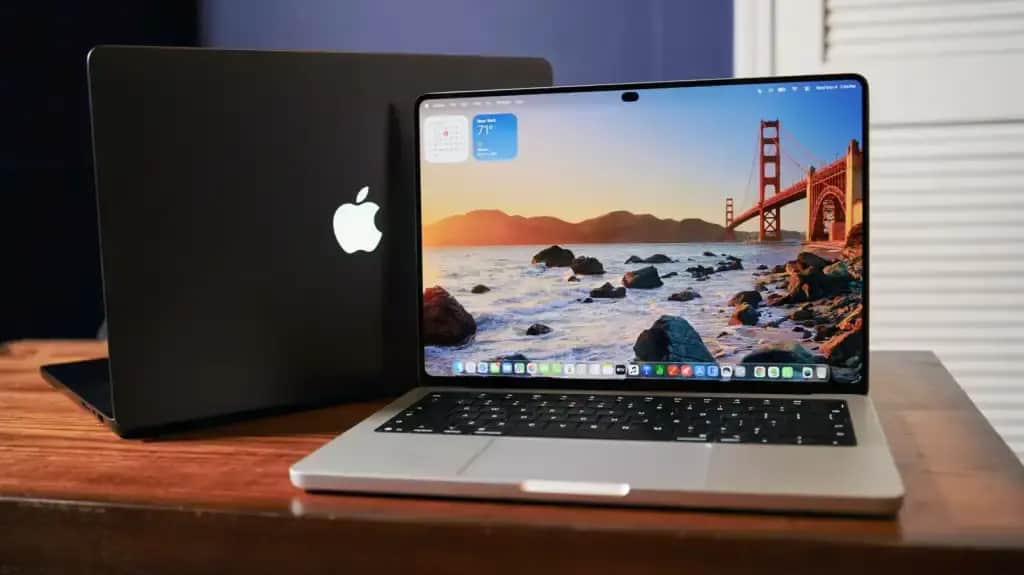
The new MacBook Pro models have OLED displays and are lighter and thinner, but cost from $2,899. According to Mezha’s account of mrf.lu’s review, touch controls add convenience but do not change the familiar macOS experience, while the display and chassis are the most noticeable upgrades.
The PROLED XDR models have screen diagonals of 14.2 inches for the smaller version and 16.3 inches for the larger one. According to the specifications cited in the review, peak HDR brightness reaches 2000 nits, sustained full-screen brightness is 1000 nits, and contrast is 10 000 000:1. OLED pixels can turn on individually, allowing the display to show deep blacks alongside bright areas.
Reported by Mezha.
At the same time, the review notes, it is difficult to spot the difference from previous Mini LED displays in everyday use. It is more pronounced in video, where dark scenes are combined with bright flashes. Dynamic Island, with the webcam, is positioned at the top of the screen; it also serves as a hub for Spotlight and Live Activities. However, in the reviewer’s assessment, this feature has little effect on the overall impression of the design.
The touchscreen lets users scroll pages, work with 3D objects and interact with other content; touches mostly work like mouse clicks. Adobe and BlackMagic plan to add support for touch features in their creative apps. However, the laptops do not support Apple Pencil, and the chassis has no mechanism for converting into a tablet. The review calls touch controls useful for certain tasks, but not a fundamentally new way to work with macOS.
According to the review, the lower weight is due to lighter OLED displays, changes to cooling and internal components. The 14-inch model weighs 3 pounds instead of 3.7, while the 16-inch model weighs 4 pounds instead of 4.7. Despite the thinner chassis, Apple has kept a wide selection of ports: three USB-C Thunderbolt 5 ports, HDMI, a headphone jack, MagSafe for charging and a full-size SD card slot.
The review also notes an upgraded six-speaker audio system: bass is richer, while sound remains clear at high volume. The keyboard and trackpad are unchanged. In the reviewer’s assessment, the combination of ports and conventional controls preserves the familiar MacBook Pro format despite the touchscreen and thinner chassis.
The new laptops use the same M5 Pro and M5 Max chips as the previous models, so the review does not expect a significant leap in performance. In Geekbench 6, the 14-inch version with an M5 Pro and 48 GB of RAM scored 4217 in the single-core test—a result the reviewer compares with other devices in the M5 family.
Battery life depends on the model and workload. The 14-inch laptop lasted about 12.5 hours in a test that included many open tabs, Slack messaging, image editing, typing, video calls and video playback. Apple says the 16-inch model can last up to 24 hours with light web browsing and 1080p video streaming. In a separate coding test, it lasted 10 hours and 15 minutes.
The 14-inch version starts at $2,899—$900 more than the standard model of that size. The 16-inch model starts at $3,399, or $400 more than the regular MacBook Pro with the same screen size. For comparison, before the June price increase, standard models started at $1,699 and $2,699, respectively; afterward, their prices rose to $1,999 and $2,999.
In the reviewer’s view, at current prices these laptops are hard to consider an obvious upgrade for the average user. OLED may justify the extra cost for those who value a high-quality display or travel frequently. The review considers the 16-inch version the better value given the price difference, while the premium for the 14-inch model makes sense primarily for those who need the lightest version. In the reviewer’s assessment, owners of recent MacBook Pro models with M5 chips have no need to rush to upgrade.