

Meta rolls out AI age assessment on Instagram worldwide
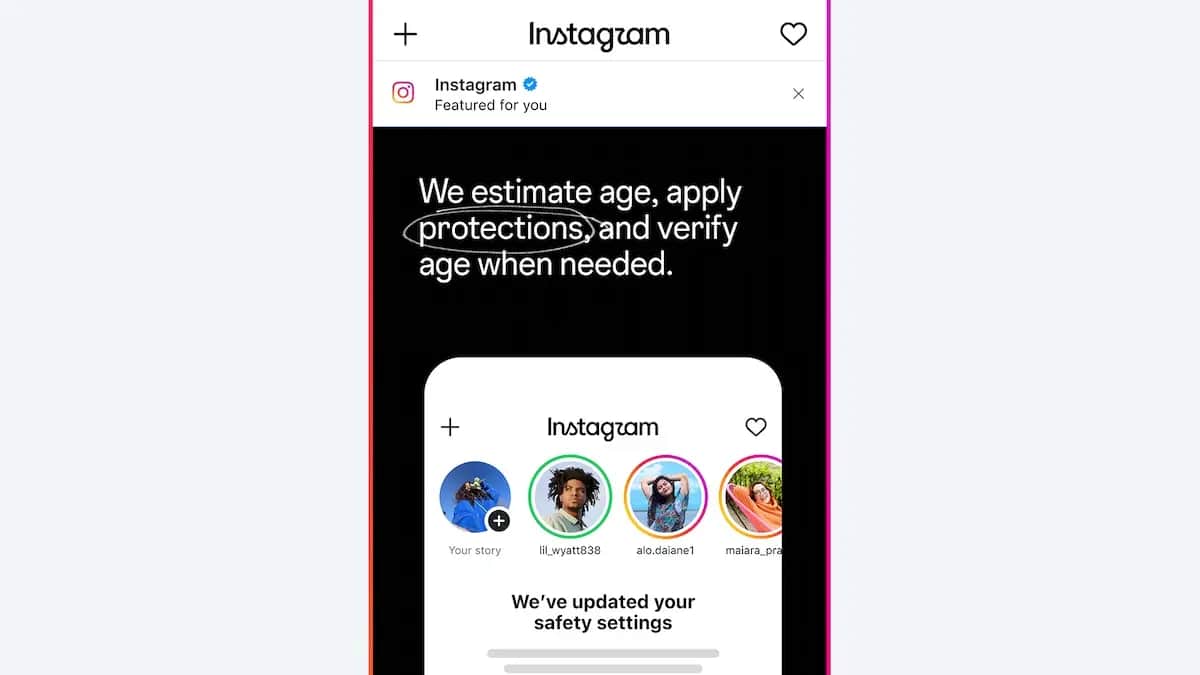
Meta has announced a global expansion of Instagram’s AI technology for estimating users’ ages, which is intended to help identify teenagers even if they entered the wrong date of birth when signing up. According to Notebookcheck, the company expects millions of young users to receive additional protections.
The technology is intended to help direct suspected teen accounts to Teen Accounts. These accounts automatically restrict who can contact younger users, what content they can access and certain aspects of their activity. Protection will no longer depend solely on the age entered at sign-up: an account whose owner said they were an adult may also be classified as a teen account.
Reported by Notebookcheck.
According to Notebookcheck, the system assesses more than just the date of birth. It can analyze profile information, posts, comments and captions, including references to a school year or birthday celebrations. Additional signals may come from photos and videos. Meta stresses that this is not facial recognition: the company says the system does not create biometric profiles of individuals.
The wider geographic rollout is not the technology’s first introduction in Europe. In May, Meta announced its expansion to the European Union and Brazil; the current announcement concerns a global rollout. This month, the company is expected to provide parents in the US with additional explanations through Instagram about its approach to age assessment and the importance of accurate age information.
Meta also plans to expand similar protections to Facebook. A global launch on Threads is expected later in 2026, according to the Notebookcheck article.
Separately, in Australia, Meta has begun using an age range from Apple as an additional source for age assessment. Parents can set such a range when preparing a smartphone for a teenager; the data may be shared with app developers participating in the program. Meta uses the signal alongside its own system, not as a replacement for it. The company has not announced this practice in Europe.
Meta has not provided a global accuracy figure or false-positive rate for the expanded system. Therefore, the company’s announcement, as reported by Notebookcheck, does not make it possible to determine how often adult users might be incorrectly classified as teenagers.