

HACC orders prosecutors to register complaint about possible payments to MPs
The High Anti-Corruption Court (HACC) upheld a complaint by the Anti-Corruption Action Center and ordered the prosecutor general or acting prosecutor general to enter information from a complaint about possible payments to MPs for voting into the Unified Register of Pre-Trial Investigations (URPTI). As of 13 November, there had been no public confirmation that the ruling had been implemented, Mezhа reports.
The Anti-Corruption Action Center said it had filed a complaint about possible payments to MPs for voting on 19 October. The HACC ruling, however, identifies it as a complaint dated 15 October. On 23 October, the organization received a response signed by Arno Lillemae, a prosecutor at the Prosecutor General’s Office: the office had forwarded the complaint to the National Anti-Corruption Bureau of Ukraine (NABU) without entering the information into the Unified Register of Pre-Trial Investigations.
Reported by Mezha.
On 4 November, HACC investigating judge Markiyan Halabala upheld the Anti-Corruption Action Center’s complaint about the prosecution’s inaction in case No991/13223/26. The court ordered the prosecutor general or acting prosecutor general to enter the information from the complaint into the URPTI. The ruling took effect immediately upon issuance. It concerned the registration of information, not establishing David Arakhamia’s guilt: the court did not consider his culpability in this ruling.
The complaint concerns possible payments to MPs mentioned amid recordings released by NABU and the Specialized Anti-Corruption Prosecutor’s Office in the “Carthage” case. In them, case suspect Andriy Osipov speaks of his intention to meet the head of a parliamentary faction whose surname is partially obscured in the video. The Chesno Movement linked the reference to Arakhamia. However, the recording establishes only Osipov’s stated intention: there is no public confirmation of a meeting or business ties between Arakhamia and Khimprom. Arakhamia denied involvement in corruption schemes.
On 11 November, Mariana Haiovska-Kovbasiuk, a representative of the Prosecutor General’s Office, told Glavkom that the office had not yet received the ruling. The Anti-Corruption Action Center stressed that a prosecutor from the Prosecutor General’s Office was in court when the decision was announced. In a response to Shelter, HACC said that the Anti-Corruption Action Center was to provide a copy. According to Mezhа, as of 13 November no public confirmation could be found that the information had been entered into the URPTI.
The situation was accompanied by public assessments of the prosecution’s independence. Martina Bohuslavets, head of the Mezhа Anti-Corruption Center, called the complaint a test of Kovalskyi’s independence from the Presidential Office. She also noted that, under Ruslan Kravchenko’s leadership, the Prosecutor General’s Office had referred to a NABU investigation which, she said, did not concern Arakhamia. On 13 November, journalist Danylo Mokryk called the situation evidence of political dependence on the part of the prosecution’s leadership. These are their assessments: the HACC ruling records the failure to enter the information but does not establish officials’ motives.
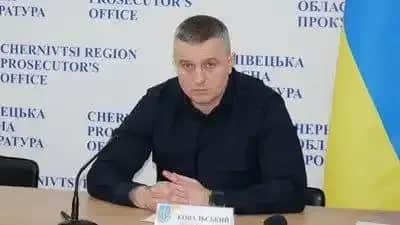
Kovalskyi had worked in the prosecution service since 2011. In November 2021, he became head of the Chernivtsi Regional Prosecutor’s Office, and from 1 July 2025, head of the Khmelnytskyi Regional Prosecutor’s Office. On 17 September 2026, Volodymyr Zelenskyy assigned him the duties of prosecutor general following Ruslan Kravchenko’s resignation. According to the Anti-Corruption Action Center, Kovalskyi was appointed head of the Khmelnytskyi prosecutor’s office without a competition after publicity surrounding regional prosecutors’ disability status claims. In a comment cited by Ukrainska Pravda, he acknowledged that the scandal had undermined public confidence in the prosecution service’s work.
Staffing issues also arose concerning Maksym Kuterha, deputy head of the Khmelnytskyi Regional Prosecutor’s Office. According to the Anti-Corruption Action Center, he was dismissed after failing the certification process in 2019 and later reinstated. The organization also raised questions about the value of property acquired by his family in 2024. In October 2026, Glavkom reported, citing sources, that Kuterha was among the prosecutors who lost administrative positions following Kovalskyi’s personnel audit.
Regarding Kovalskyi’s appointment itself, Ukrainska Pravda, recounting a report by Dzerkalo Tyzhnia and citing sources, wrote of possible influence by businessman Illia Pavliuk. Suspilne reported, citing its own information, that the candidate had been recommended by Oleh Tatarov, deputy head of the Presidential Office. In a conversation with Glavkom, Kovalskyi said he had never seen Pavliuk or Arakhamia and had never met Tatarov in person. According to Mezhа’s report, there was no public document confirming Pavliuk’s role in the appointment.
Separately, on 10 November, the Prosecutor General’s Office announced that Kovalskyi had issued an order for an official investigation. It is examining whether prosecution service employees helped return property seized in proceedings concerning call centers and the U420 network. Kovalskyi also reported the registration of a case concerning the possible use of an official vehicle by Serhii Kropyva for private trips. As of 13 November, no results of the official investigation had been reported.
In his 2025 declaration, Kovalskyi listed more than 2,5 million UAH in income received from the Chernivtsi and Khmelnytskyi regional prosecutor’s offices. His wife’s business income was about 3,55 million UAH. According to Ukrainska Pravda, for the incomplete 2023 year she declared about 5,2 million UAH after registering as an individual entrepreneur in March. These are declared income figures: business expenses and net profit cannot be determined from these amounts.
The declaration also lists an apartment in Chernivtsi that the city council granted Kovalskyi the right to use from 27 January 2025. In July, he moved to work in Khmelnytskyi. Ukrainska Pravda contacted the city council about the housing status and whether the right of use remained valid, but its report does not include the council’s response. Thus, as of 13 November, it remained unclear whether the right to use the apartment continued after his move to another region.
The Anti-Corruption Action Center also drew attention to property declared earlier. This includes a 79 m2 apartment in Vinnytsia used by Kovalskyi’s family and listed as his mother’s property in declarations for 2018–2023, according to Ukrainska Pravda. The organization raised questions about the source of funds used to acquire it, but the declaration entries themselves do not make it possible to establish those sources. The 2018 declaration also listed a Volkswagen Polo belonging to the prosecutor’s brother, which Kovalskyi used.