

Apple launches study in the US on how people interact with medical AI
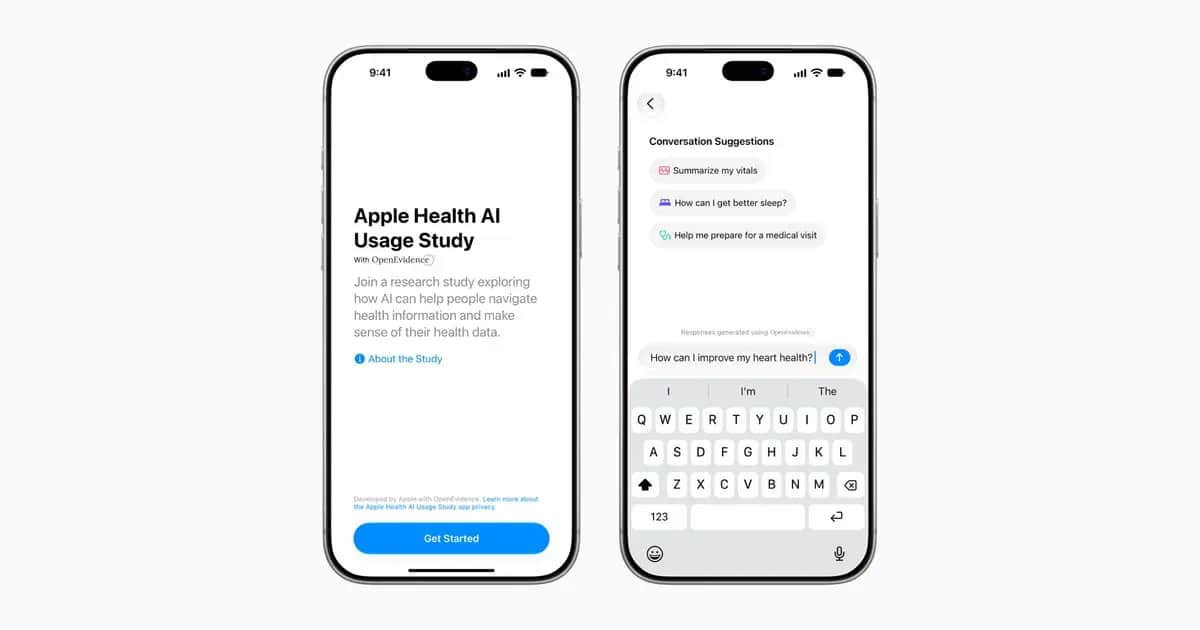
Apple has announced the launch in the US of the virtual Apple Health AI Usage Study, examining how people use conversational artificial intelligence tools to ask health-related questions. The company wants to assess trust in these systems, the quality of their answers and how users understand the information they receive.
The study is being conducted in partnership with OpenEvidence. According to Apple, the project combines the platform’s medically focused AI technology with a research interface developed by Apple. The company plans to study not only how people perceive answers but also their everyday health-related actions, so the findings can help guide the responsible design of medical AI tools. Apple describes OpenEvidence as a clinical AI platform that generates answers based on medical information from established sources, including The New England Journal of Medicine, the Journal of the American Medical Association and Nature.
Reported by apple.com.
Participants will be able to ask the app everyday health questions, review explanations of complex medical information in more accessible language and open links to peer-reviewed clinical sources cited in the answers. The study is not just about assessing whether the answers are understandable: Apple also wants to examine how people interact with these systems in everyday life. Another focus is whether medical AI can help participants better prepare for appointments with their own doctors.
Another research question is how personal health information affects the relevance and clarity of answers. Participants can decide for themselves whether to provide HealthKit data; Apple lists resting heart rate, activity, sleep and lab results among the possible indicators. The company does not claim that integrating this data will necessarily improve answers: researchers will assess its effect on relevance and understanding. Providing these indicators is up to each participant.
Apple says the study is needed because consumer health tools based on large language models can sometimes provide incomplete or unclear answers. The project is intended to help determine how to present medical information more clearly. The app also includes safeguards: according to the company, they are designed to identify certain potentially concerning questions and suggest that the user contact a medical professional or other resources.
The company says the study data will not be used to train artificial intelligence models. Participants will remain in control of whether they share HealthKit indicators or survey responses. Apple also says it has put measures in place to protect the data it stores as part of the study and participants’ privacy. Thus, both sharing individual health indicators and submitting survey responses will depend on their choice.
Up to 200 thousand people aged 21 and older can take part in the study in the US. Participation requires an iPhone that supports Apple Intelligence — an iPhone 15 Pro or a newer model — with iOS 26 or a newer version of the operating system installed. According to Apple, those interested can download the study app, review information about the project and decide whether to participate.
Apple stresses the limits of the app’s intended use: it is not designed to diagnose or treat diseases and does not replace advice from medical professionals. The company says participants should contact a doctor or clinician about health concerns or to verify medical information. The study is intended to examine how people interact with medical AI, not to provide medical care in place of professionals.